
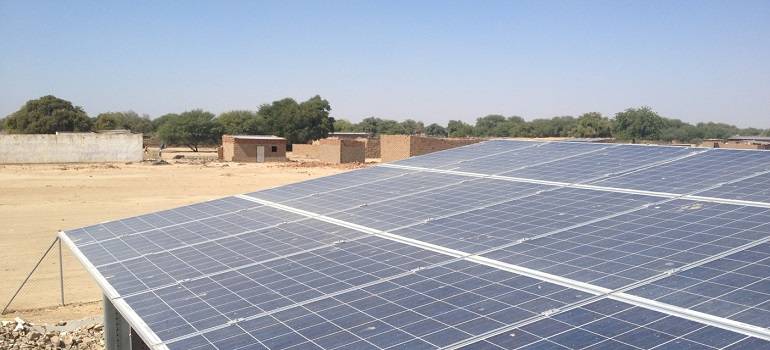
Solar Plant with Net Metering
📍Manufactured in New Delhi, Delhi, India
<div class="section_header" style="box-sizing: border-box; color: rgb(71, 71, 71); font-family: ralewayregular; font-size: 14px;"> <h1>General Technical specifications</h1> <p><u><strong>1. SPV Modules</strong></u></p> </div> <p> </p> <ul> <li><span style="font-size:20px">Indigenously manufactured PV modules should be used.</span></li> <li><span style="font-size:20px">The PV module should have crystalline silicon solar cells and must have a certificate of testing conforming to IEC 61215 Edition II / BIS 14286 from an NABL or IECQ accredited Laboratory.</span></li> <li><span style="font-size:20px">The power output of the module(s) under STC should be a minimum of 100 Wp at a load voltage* of 16.4 ± 0.2 V. V<span style="font-size:15px">nom </span>12V.</span></li> <li><span style="font-size:20px">The open circuit voltage* of the PV modules under STC should be at least 21.0 Volts.</span></li> <li><span style="font-size:20px">The module efficiency should not be less than 14 %.</span></li> <li><span style="font-size:20px">The terminal box on the module should have provision for opening to replace the cable, if required.</span></li> <li><span style="font-size:20px">PV modules must be warranted for their output peak watt capacity which should not be less than 90 % at the end of 10 years and 80% at the end of 25 years.</span></li> <li><span style="font-size:20px">Identification and Traceability</span></li> </ul> <p><span style="font-size:20px">Each PV module used in any solar power project must use a RF identification tag. The following information must be mentioned in the RFID used on each module (This should be inside the laminate and must be able to withstand harsh environmental conditions.)</span></p> <ul> <li><span style="font-size:20px">Name of the Manufacturer of PV module</span></li> <li><span style="font-size:20px">Name of the manufacturer of Solar Cells.</span></li> <li><span style="font-size:20px">Month and year of the manufacture (separately for solar cells and module).</span></li> <li><span style="font-size:20px">Country of origin (separately for solar cells and module).</span></li> <li><span style="font-size:20px">I-V curve for the module.</span></li> <li><span style="font-size:20px">Peak wattage, Im ,Vm and FF for the module.</span></li> <li><span style="font-size:20px">Unique serial no and model no of the module.</span></li> <li><span style="font-size:20px">Date and year of obtaining IEC PV module qualification certificate.</span></li> <li><span style="font-size:20px">Name of test lab issuing IEC certificate</span></li> <li><span style="font-size:20px">Other relevant information on traceability of solar cells and module as per ISO 9000 series.</span></li> </ul> <p> </p> <p><span style="font-size:20px"><u><strong>2. Battery</strong></u></span></p> <p> </p> <ul> <li><span style="font-size:20px">Tubular Lead Acid battery having minimum rating of 2 V 200Ah &12V, 150 Ah & higher capacities at C/10 discharge rate.</span></li> <li><span style="font-size:20px">75% of the rated capacity of the battery should be between fully charged and load cut off conditions.</span></li> <li><span style="font-size:20px">Battery should conform to the latest BIS/ International standards.</span></li> </ul> <p> </p> <p><span style="font-size:20px"><u><strong>3. Balance of system (BOS)</strong></u></span></p> <ul> <li><span style="font-size:20px">Cables should confirm to applicable standards i,e IEC 60189, IS 694/ IS1554, IS/IEC 69947.</span></li> <li><span style="font-size:20px">Switches / Circuit Breakers / Connector should confirm to IS/IEC 60947 part I,II,III, EN 50521 standards.</span></li> <li><span style="font-size:20px">Junction Boxes should confirm to IP 65 for outdoor / IP 21 for indoor use and IEC 62208 standards.</span></li> <li><span style="font-size:20px">SPV system design should confirm to IEC 62124 standards</span></li> <li><span style="font-size:20px">Installation of systems should confirm to IEC 60364-7-712 standards</span></li> </ul> <p> </p> <p><span style="font-size:20px"><u><strong>4. Power Conditioning Unit (PCU)</strong></u></span></p> <p><span style="font-size:20px">The <strong>PCU</strong> should convert DC power produced by SPV modules, in to AC power and adjust the voltage & frequency levels to suit the local grid conditions. The inverter shall interconnect and feed power to the LT power supply of the building and also shall have the provision to power critical loads.</span></p> <p><span style="font-size:20px"><strong>Common Technical Specification :</strong></span></p> <p><span style="font-size:20px">Control Type : Voltage source, microprocessor assisted , output regulation</span></p> <p><span style="font-size:20px">Out put voltage : Single Phase, 230 V ac ( +12.5 %, - 20 % V ac)</span></p> <p><span style="font-size:20px"> : 3 phase, 415 V ac ( +12.5 %, - 20 % V ac)</span></p> <p><span style="font-size:20px">Frequency: 50 Hz ( +3 Hz, -3 Hz)</span></p> <p><span style="font-size:20px">Total Harmonic Distortion : less than 3%</span></p> <p><span style="font-size:20px">Operating temperature Range : 0 to 55 deg C</span></p> <p><span style="font-size:20px"><strong><u>Inverter standards :</u></strong></span></p> <p><span style="font-size:20px">Inverter should comply with IEC 61683/IS 61683 for efficiency and Measurements and should comply IEC 60068-2 (1, 2, 14, 30) / Equivalent BIS Standard for environmental testing. Inverter should supervise the grid condition continuously and in the event of grid failure (or) under voltage (or) over voltage, Solar System should be disconnected by the circuit Breaker / Auto switch provided in the inverter. </span></p> <p><span style="font-size:20px">Power Control : MPPT</span></p> <p><span style="font-size:20px">Other important Features/Protections required in the INVERTER</span></p> <ul style="list-style-type:square"> <li><span style="font-size:20px">Automatic morning wake-up and nightly shutdown</span></li> <li><span style="font-size:20px">Mains (Grid) over-under voltage and frequency protection</span></li> <li><span style="font-size:20px">Fool proof protection against ISLANDING.</span></li> <li><span style="font-size:20px">Included authentic tracking of the solar array’s maximum power operation voltage (MPPT).</span></li> <li><span style="font-size:20px">Array ground fault detection.</span></li> <li><span style="font-size:20px">LCD and piezoelectric keypad operator interface Menu driven</span></li> <li><span style="font-size:20px">Automatic fault conditions reset for all parameters like voltage, frequency and/or black out.</span></li> <li><span style="font-size:20px">Surge arresters on AC and DC terminals for over voltage protection from lightning-induced surges.</span></li> <li><span style="font-size:20px">INVERTER should be rated to operate at 0 –55 deg. Centigrade unless provision for air conditioning is included in INVERTER</span></li> <li><span style="font-size:20px">All parameters should be accessible through an industry standard communication link.</span></li> </ul> <ul style="list-style-type:square"> <li><span style="font-size:20px">Overload capacity (for 10 sec) should be 150 % of continuous rating</span></li> </ul> <p> </p> <p><span style="font-size:20px"><strong><u>Harmonics Standard :</u></strong></span></p> <p><span style="font-size:20px">As per the standard of IEEE 519, the permissible individual harmonics level shall be less than 3% (for both voltage and current harmonics) and Total Harmonics Distortion (THD) for both voltage and current harmonics of the system shall be less than 5%.</span></p> <p><span style="font-size:20px"><strong><u>Technical and interconnection requirements</u></strong></span></p> <div style="box-sizing: border-box; color: rgb(71, 71, 71); font-family: ralewayregular; font-size: 14px;"> </div> <div style="box-sizing: border-box; color: rgb(71, 71, 71); font-family: ralewayregular; font-size: 14px;"> <table border="1" cellpadding="0" cellspacing="0" class="tbl1" style="background-color:transparent; border-collapse:collapse; border-spacing:0px; border:1px solid rgb(0, 0, 0); box-sizing:border-box; line-height:20.8px"> <tbody> <tr> <td> <p><span style="font-size:20px"><strong>Overall conditions of service </strong></span></p> </td> <td> <p><span style="font-size:20px"><strong>State Distribution/Supply Code </strong></span></p> </td> <td> <p><span style="font-size:20px"><strong>State Distribution/Supply Code </strong></span></p> </td> </tr> <tr> <td> <p><span style="font-size:20px"><strong>Overall Grid Standards </strong></span></p> </td> <td> <p><span style="font-size:20px">Central Electricity Authority (Grid Standard) Regulations 2010 </span></p> </td> <td> <p><span style="font-size:20px">Central Electricity Authority (Grid Standard) Regulations 2010 </span></p> </td> </tr> <tr> <td> <p><span style="font-size:20px"><strong>Equipment </strong></span></p> </td> <td> <p><span style="font-size:20px">BIS / IEC / IEEE </span></p> </td> <td> <p><span style="font-size:20px">BIS / IEC / IEEE </span></p> </td> </tr> <tr> <td> <p><span style="font-size:20px"><strong>Meters</strong></span></p> </td> <td> <p><span style="font-size:20px">Central Electricity authority (Installation & operation of meters) Regulation 2006 as amended time to time </span></p> </td> <td> <p><span style="font-size:20px">Central Electricity authority (Installation & operation of meters) Regulation 2006 as amended time to time </span></p> </td> </tr> <tr> <td> <p><span style="font-size:20px"><strong>Safety and supply </strong></span></p> </td> <td> <p><span style="font-size:20px">Central Electricity Authority(measures of safety and electricity supply) Regulations, 2010 </span></p> </td> <td> <p><span style="font-size:20px">Central Electricity Authority(measures of safety and electricity supply) Regulations, 2010 </span></p> </td> </tr> <tr> <td> <p><span style="font-size:20px"><strong>Harmonic Requirements Harmonic Current </strong></span></p> </td> <td> <p><span style="font-size:20px">IEEE 519 CEA (Technical Standards for Connectivity of the Distributed Generation Resources) Regulations 2013 </span></p> </td> <td> <p><span style="font-size:20px">IEEE 519 CEA (Technical Standards for Connectivity of the Distributed Generation Resources) Regulations 2013 </span></p> </td> </tr> <tr> <td> <p><span style="font-size:20px"><strong>Synchronization </strong></span></p> </td> <td> <p><span style="font-size:20px">IEEE 519 CEA (Technical Standards for Connectivity of the Distributed Generation Resources) Regulations 2013 </span></p> </td> <td> <p><span style="font-size:20px">Photovoltaic system must be equipped with a grid frequency synchronization device. Every time the generating station is synchronized to the electricity system. It shall not cause voltage fluctuation greater than +/- 5% at point of connection. </span></p> </td> </tr> <tr> <td> <p><span style="font-size:20px"><strong>Voltage </strong></span></p> </td> <td> <p><span style="font-size:20px">IEEE 519 CEA (Technical Standards for Connectivity of the Distributed Generation Resources) Regulations 2013 </span></p> </td> <td> <p><span style="font-size:20px">The voltage-operating window should minimize nuisance tripping and should be under operating range of 80% to 110% of the nominal connected voltage. Beyond a clearing time of 2 second, the photovoltaic system must isolate itself from the grid. </span></p> </td> </tr> <tr> <td> <p><span style="font-size:20px"><strong>Flicker </strong></span></p> </td> <td> <p><span style="font-size:20px">IEEE 519 CEA (Technical Standards for Connectivity of the Distributed Generation Resources) Regulations 2013 </span></p> </td> <td> <p><span style="font-size:20px">Operation of Photovoltaic system should not cause</span></p> </td> </tr> <tr> <td> <p><span style="font-size:20px"><strong>Frequency </strong></span></p> </td> <td> <p><span style="font-size:20px">IEEE 519 CEA (Technical Standards for Connectivity of the Distributed Generation Resources) Regulations 2013 </span></p> </td> <td> <p><span style="font-size:20px">When the Distribution system frequency deviates outside the specified conditions (50.5 Hz on upper side and 47.5 Hz on lower side), There should be over and under frequency trip functions with a clearing time of 0.2 seconds. </span></p> </td> </tr> <tr> <td> <p><span style="font-size:20px"><strong>DC injection </strong></span></p> </td> <td> <p><span style="font-size:20px">IEEE 519 CEA (Technical Standards for Connectivity of the Distributed Generation Resources) Regulations 2013 </span></p> </td> <td> <p><span style="font-size:20px">Photovoltaic system should not inject DC power more than 0.5% of full rated output at the interconnection point or 1% of rated inverter output current into distribution system under any operating conditions. </span></p> </td> </tr> <tr> <td> <p><span style="font-size:20px"><strong>Power Factor </strong></span></p> </td> <td> <p><span style="font-size:20px">IEEE 519 CEA (Technical Standards for Connectivity of the Distributed Generation Resources) Regulations 2013 </span></p> </td> <td> <p><span style="font-size:20px">The photovoltaic system in the event of fault, voltage or frequency variations must island/disconnect itself within IEC standard on stipulated period. </span></p> </td> </tr> <tr> <td> <p><span style="font-size:20px"><strong>Overload and Overheat </strong></span></p> </td> <td> <p><span style="font-size:20px">IEEE 519 CEA (Technical Standards for Connectivity of the Distributed Generation Resources) Regulations 2013 </span></p> </td> <td> <p><span style="font-size:20px">The inverter should have the facility to automatically switch off in case of overload or overheating and should restart when normal conditions are restored. </span></p> </td> </tr> <tr> <td> <p><span style="font-size:20px"><strong>Paralleling Device </strong></span></p> </td> <td> <p><span style="font-size:20px">IEEE 519 CEA (Technical Standards for Connectivity of the Distributed Generation Resources) Regulations 2013 </span></p> </td> <td> <p><span style="font-size:20px">Paralleling device of photovoltaic system shall be capable of withstanding 220% of the normal voltage at the interconnection point. </span></p> </td> </tr> </tbody> </table> <p><span style="font-size:20px"><strong>Meter Configuration options</strong></span></p> <p><span style="font-size:20px"> The metering system for rooftop solar system, under net-metering arrangement, shall be as elaborated below which should be applicable till such time the Central Electricity Authority notifies the standards in this matter.</span></p> <p><span style="font-size:20px"><strong>a) Two Meter Configuration without Storage </strong>The metering protocol for ‘Grid connected rooftop solar PV system without storage’ and location of solar meter and consumer meter shall be in accordance with the schematic below:-</span></p> <p style="text-align:center"><img alt="Dig1" src="http://solarpunjab.com/img/dig1.jpg" style="border:0px; box-sizing:border-box; vertical-align:middle" /></p> <p><span style="font-size:20px">The utility meter (Net-meter) has to be bi-directional meter to register both import grid electricity amount as well as export solar electricity amount. </span></p> <p> </p> <p><span style="font-size:20px"> <strong>Two Meter Configuration with Storage </strong>The metering protocol for ‘Grid connected rooftop solar PV system with storage’ and location of Solar Meter (SM) and Utility Meter (UM) shall be in accordance with the schematic below:- </span></p> <p style="text-align:center"><img alt="Dig2" src="http://solarpunjab.com/img/dig2.jpg" style="border:0px; box-sizing:border-box; vertical-align:middle" /></p> <p><span style="font-size:20px">The utility meter (Net-meter) has to be bi-directional meter to register both import grid electricity amount as well as export solar electricity amount.</span></p> <p> </p> <p><span style="color:rgb(110, 110, 110); font-family:open sans,sans-serif; font-size:17px">As regards to installation; </span><br /> <span style="color:rgb(110, 110, 110); font-family:open sans,sans-serif; font-size:17px">Time taken to commission and handover the plant was approximately 2 months as the roof of the factory was highly fragile. </span><br /> <span style="color:rgb(110, 110, 110); font-family:open sans,sans-serif; font-size:17px">Net Metering was also a herculean task as this was the first large scale commercial solar installation in the region. </span><br /> <br /> <span style="color:rgb(110, 110, 110); font-family:open sans,sans-serif; font-size:17px">We are grateful to our Solar Module Manufacturers (SunFuel Technologies), our principal partners in Sonipat & Hissar and the PO, SDO and Net Metering Officials of Sonipat District in Haryana. </span></p> <div class="clr3 fnt6 fnt17 bo1" style="margin: 0px; padding: 0px; font-size: 21px; font-family: "Roboto Condensed", Arial, Helvetica, sans-serif; color: rgb(255, 255, 255);"><span style="color:rgb(110, 110, 110); font-family:open sans,sans-serif; font-size:17px">Request<br /> <strong>Callback</strong></span></div> <div class="bg18 ps1" style="margin: -32px 0px 0px; padding: 0px; border-bottom: 14px solid rgb(3, 3, 3); border-left: 10px solid transparent; top: 0px; right: 102px; position: absolute; color: rgb(110, 110, 110); font-family: "Open Sans", sans-serif; font-size: 17px; text-align: justify;"> </div> <br /> <p style="text-align:justify"><strong>Additional Information:</strong></p> <ul> <li><strong>Pay Mode Terms: </strong>T/T (Bank Transfer),Other</li> </ul> <p> </p> <p>Price : <span style="color:rgb(34, 34, 34); font-family:arial,sans-serif; font-size:12.8px">Rs 55,000 to Rs 75,000/KW</span></p> <p> </p> <p> </p> </div>